Charles Turnell is showing “Fields of Memory in the Heartland” at the WINDOW ON FORSYTH space (viewable 24/7, 7513 Forsyth Blvd., Clayton MO)
Charles Turnell writes: “Stamped: The Making of America 250 commemorates the 250th anniversary of the United States through a visual language built from fragments of national memory. Using individually photographed American postage stamps dating from 1927 to 1985, I created this series to reflect on the symbols, ideals, contradictions, and aspirations that continue to shape the American experience. A milestone approach.
The work is created through my signature process, Ars Musiva, a contemporary mosaic language that brings together photography, digital painting, and layered visual construction. In this process, each stamp becomes both material and metaphor. These small civic objects once moved quietly through everyday life, carrying images of presidents, monuments, landscapes, inventions, flags, and historic moments. Reassembled into larger compositions, they invite us to reconsider how a nation remembers itself.
I do not see America as a single story. I see it as a living mosaic, formed through overlapping histories, competing ideals, shared struggles, and unfinished promises. Embedded in these works are symbols of liberty, democracy, labor, expansion, agriculture, civil rights, innovation, and technological ambition. Together, they trace the evolving shape of American identity, from the Declaration of Independence and westward expansion to the Civil War, the Civil Rights Movement, the Moon Landing, and the Information Age.
At the center of this project is a question:
What does a nation choose to remember, and what does it choose to symbolize?
Postage stamps hold a unique place in our national memory. To appear on a stamp is to be selected into the visual archive of a country. These miniature artifacts carry decisions about identity, value, power, and belonging. When I reassemble them into mosaics, they become layered archives where history is preserved, fragmented, and reinterpreted.
Visually, the works move between painting and photography, abstraction and representation. From a distance, familiar American images begin to emerge. Up close, the surface breaks apart into hundreds of individual stamps, each carrying its own history. That tension between the larger image and the smaller fragments reflects the way I think about America itself: complex, unfinished, beautiful, difficult, and still becoming.
Produced as limited-edition archival prints, Stamped: The Making of America 250 is both a commemoration and an invitation to reflect. This series is not about nostalgia. It is about memory, inheritance, and the question of whether fragments of history can still form a shared vision of belonging.
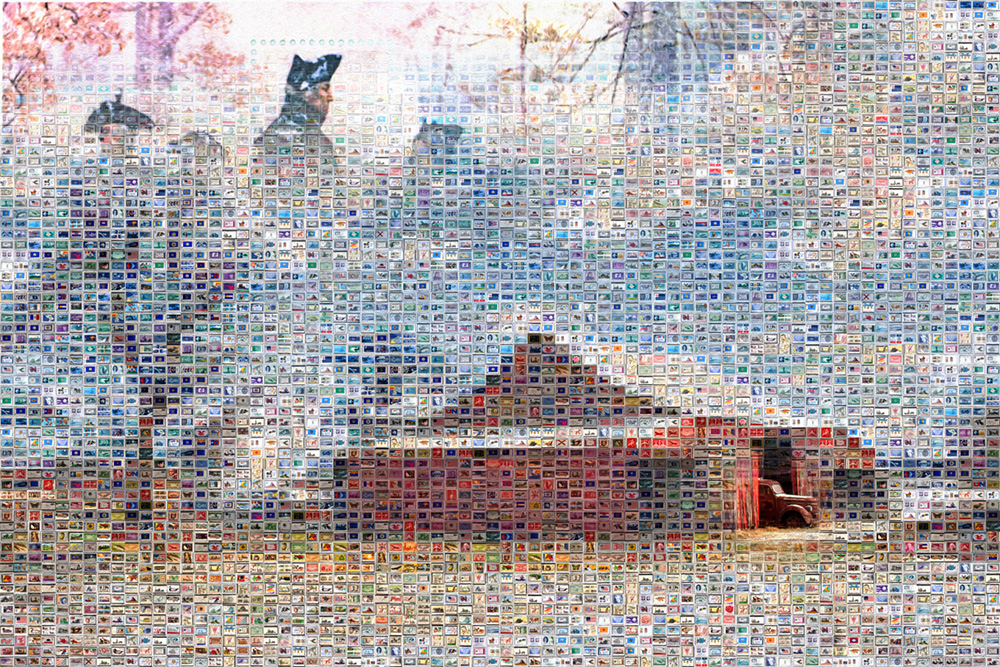
The First Furrow West: Fields of Memory in the Heartland
The First Furrow West reflects one of America’s earliest steps beyond the edge of the original thirteen colonies and into the Ohio Valley, a region that would become the beginning of the American heartland.
In this piece, the farm, barn, silo, open field, and weathered truck stand as quiet symbols of a nation taking root. The landscape feels still, yet it carries the weight of history. It speaks to labor, migration, agriculture, settlement, and the enduring hope that land could become home.
The Ohio Valley was more than a frontier on a map. It was a threshold a place where the young republic began to imagine itself as something larger, more expansive, and more complex than where it began.
Created from hundreds of postage stamps, this work becomes a field of memory. Each stamp holds a fragment of America’s official story, while together they form a larger meditation on expansion, cultivation, promise, and consequence. The heartland was shaped through vision and hard work, but also through displacement and contested land. That tension, too, is part of the American story.
The barn rises almost like a monument. The truck rests at the edge of the field as a reminder of the generations who worked the land, carried its burdens, and helped move the country forward. The stamps, placed one by one, feel like seeds of memory small fragments that come together to reveal a larger inheritance.
This piece asks us to reflect on how a nation grows not only through lines drawn on maps, but through the lives, labor, sacrifice, and stories layered into the land itself.”
 GOOD ART NEWS
You must be logged in to post a comment.